
Usually between three and six months for the tender, depending on the size of the site and the number of providers consulted. Implementation and stock transfer then take from several weeks to several months. We set a precise schedule from the outset and share it with you.
Logistics Tender
Find the logistics provider that fits your flows, in France, the United States or Asia, negotiate the best terms and make your stock transfer a success.
Who is it for?
Companies that outsource their warehousing, or plan to, in France, the United States or Asia, and want to compare their current provider with the market.
What we do
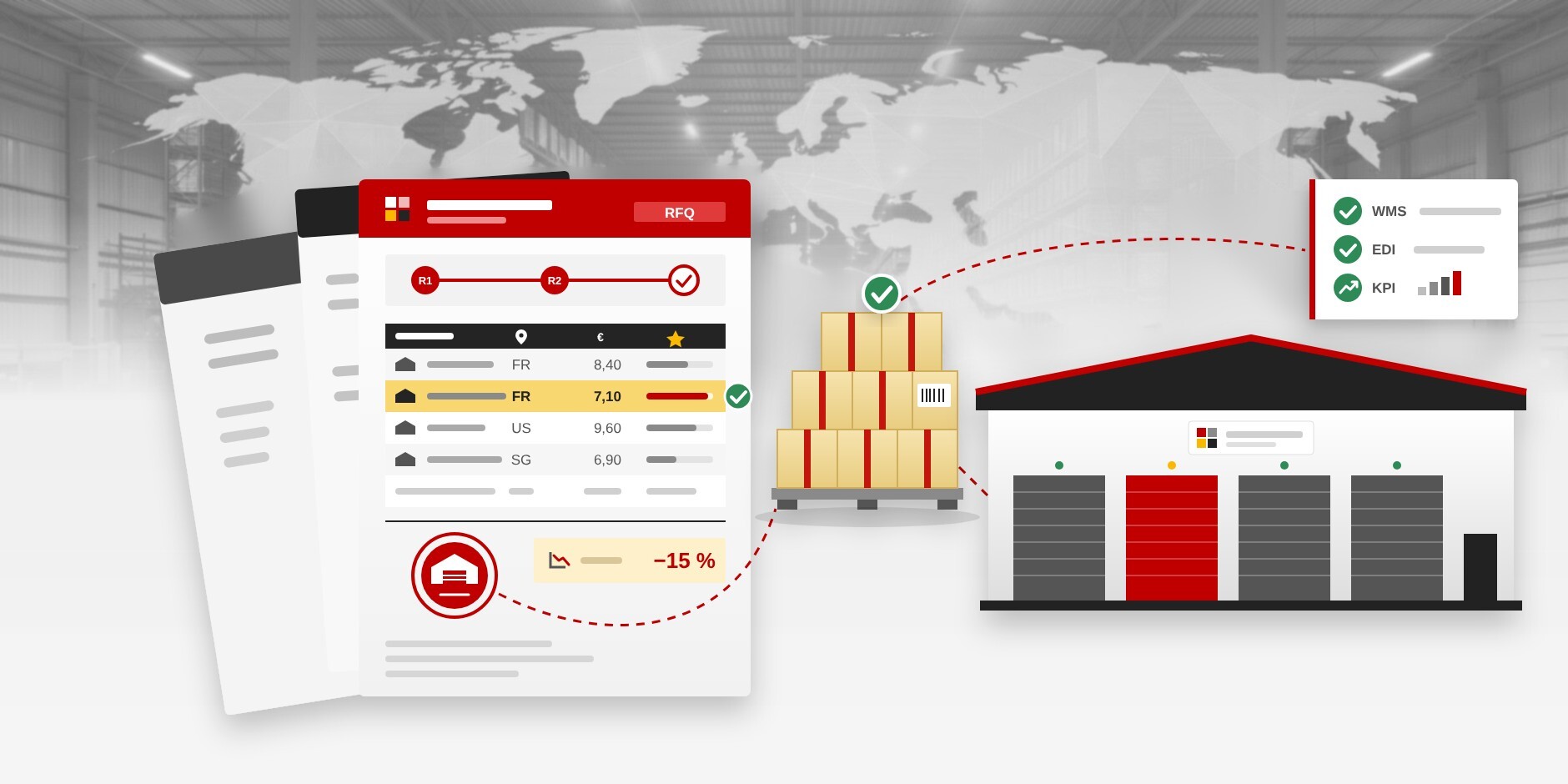
We run your logistics tender from A to Z, then, if you wish, support the implementation of the selected provider, right through to the stock transfer.
What you get
A clear comparison of offers, negotiated terms, three summary reports and a well-managed start in the new warehouse.
Objective
A logistics contract commits you for several years: storage and order-picking costs, service quality, IT systems. Without competitive bidding, rates drift and the organisation no longer keeps pace with your flows. And changing provider is often a worry: stock transfer, IT interfaces, continuity of deliveries.
Our goal: to compare your current provider objectively with the market, choose the solution best suited in terms of cost and service, then secure the transition through to start-up in the new warehouse.
Situations we encounter most often
- Storage and order-picking rates never renegotiated
- Picking errors, late shipments or unreliable inventories
- A warehouse that is saturated or poorly located in relation to your customers
- Plans to set up logistics in the United States or Asia
- A change of provider postponed for fear of the stock transfer
How the assignment works
Two phases: the tender, then, as an option, the implementation and monitoring of the selected provider.
-
01
Specifications
Together we describe your flows, volumes, service requirements and IT needs, and set the project schedule.
-
02
Consultation
We select the providers, in France, the United States or Asia, launch the tender and run the follow-up meetings.
-
03
Negotiation
Two rounds of analysis and negotiation, each concluded by a comparative report.
-
04
Decision
A final report and our recommendation so you can choose your provider with full knowledge of the facts.
-
05
Implementation (optional)
Mapping of data exchanges, transition plan, coordination of your teams and organisation of the stock move.
-
06
Monitoring (optional)
Regular performance reviews and support during annual renegotiations.
Our commitments
Independence
We defend your interests, with no ties to the providers consulted.
Transparency
Every step is documented and shared: minutes, reports, comparisons.
International perspective
Knowledge of logistics markets in France, the United States and Asia.
Decision support
Well-argued recommendations; the final decision is yours.
Your benefits
Controlled costs
Your provider is compared with the market, item by item: storage, picking, shipping.
A secure transfer
The stock move is planned to keep your deliveries running.
Systems that talk to each other
Data exchanges between your tools and the provider’s are framed from the outset.
Monitored performance
Shared indicators to check that commitments are met.
Mission example
Cybersecurity and software development, SME
For this SME, we ran a logistics tender in the United States with 3 providers, from January to April 2026. The comparison revealed a 53% gap between the most expensive and the most competitive offer, around $4,800 per year.
3
logistics providers consulted
4 months
of project
53%
gap between the most expensive and the most competitive offer
How long does a logistics tender take?
Can you work abroad?
Yes. We run logistics tenders in France, the United States and Asia, for a single warehouse or a network of several sites.
Can our current provider take part?
Yes, and it is even recommended. It is consulted on the same terms as the others. The tender often makes it possible to renegotiate with it on an objective basis, without necessarily changing provider.
What do the specifications contain?
A description of your flows (receiving, storage, order picking, shipping, returns), your volumes and their seasonality, your quality requirements, your storage constraints and your IT needs. This is the basis for comparing offers on identical criteria.
What is a WMS and why does it matter?
The WMS (Warehouse Management System) is the provider’s warehouse management software: it tracks stock, orders and shipments. We check that it can exchange data properly with your own tools (ERP, e-commerce site) and frame these exchanges in IT specifications.
How does the stock transfer work?
Together with you and both providers, we prepare a transition plan: inventory, moving schedule, safety stock, IT testing. The aim is to keep any interruption of deliveries to your customers to a minimum.
Is the implementation phase mandatory?
No. You can end the assignment once the provider has been chosen. Implementation is, however, recommended whenever there is a stock move or new IT interfaces to set up.
Can you help us choose between outsourcing and keeping logistics in-house?
Yes. This question is covered by our logistics analysis and optimisation assignment, which can precede the tender: we compare both options in terms of cost, service and risk.
You may also be interested in
Is your logistics provider still the right one?
Let’s talk: 30 minutes, free of charge and with no commitment.


