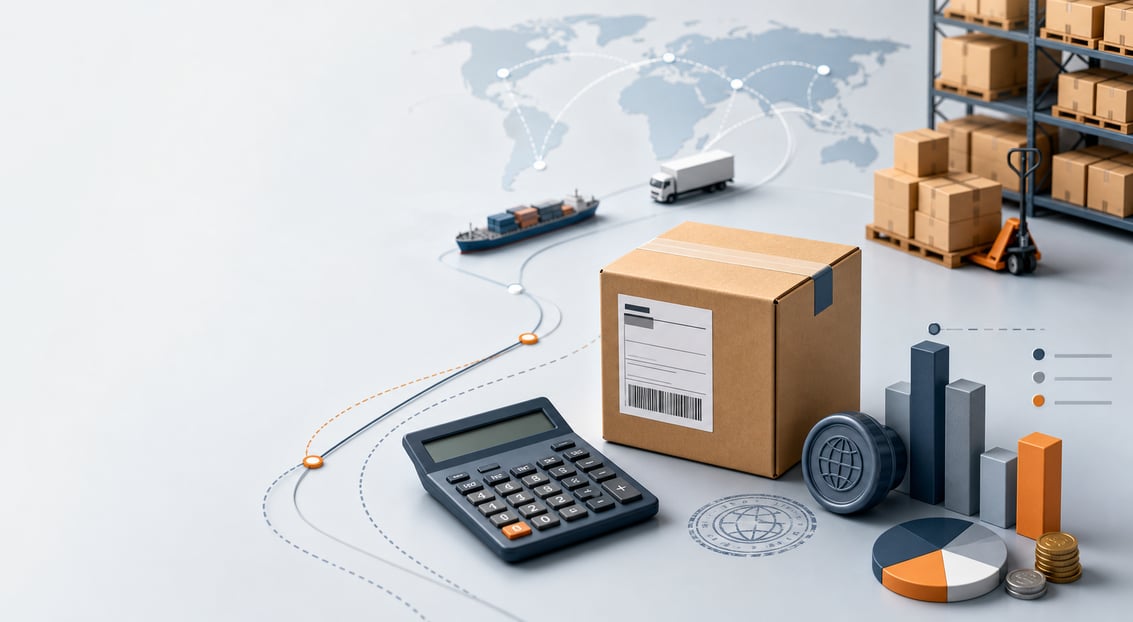
Executive Summary: Since 1 July 2026, the European Union has applied a flat-rate customs duty of €3 per item category on low-value imported parcels worth €150 or less. The French €2 tax has been suspended. Flows diverted through Belgium are returning to France. For businesses, landed cost must be recalculated immediately — basket composition, VAT and the European handling fee included .
The issue of e-commerce customs duties reached a decisive milestone on 1 July 2026. France had led the way on 1 March 2026 with a temporary national €2 tax. In practice, however, the measure was largely neutralised by the logistics networks of Chinese platforms, which shipped their goods by air to other European countries — particularly Belgium — before transporting them by road into France. The shift in volumes was estimated at “around 90% since 1 March” by the Director General of French Customs, with revenue of only €2.3 million per month, far below the €400 million expected over the year.
The government announced that the French measure would be suspended as of 1 July in order to avoid its cumulative application with the new European flat-rate customs duty of €3, which entered into force on the same date. This shift from a national to a European measure is not simply the replacement of one tax line by another: it reshapes the entire calculation of landed cost for e-commerce imports.
For businesses, three issues are now on the table: recalculating costs, securing customs data, and anticipating the return of significant volumes to the French road network.
What the European €3 customs duty has concretely changed since 1 July 2026
The change is structural, not temporary. Until now, parcels worth less than €150 were exempt from customs duties. This exemption, originally designed to simplify the processing of low-value consignments, is now considered unsuitable for the rapid growth of e-commerce.
Since 1 July 2026, the European Union has applied a flat-rate customs duty of €3 per item category on parcels imported from outside the EU with a value below €150 (Regulation (EU) 2026/382). Parcels resulting from distance sales of imported goods with an intrinsic value of €150 or less are subject to the €3 flat-rate duty per item category. Standard B2B flows and certain specific cases must be assessed separately, as they may fall under the Common Customs Tariff or a specific customs regime. The long-standing customs duty exemption for distance sales of low-value goods has therefore been abolished.
The €3 flat-rate duty mainly concerns distance sales of imported goods, i.e. B2C e-commerce flows. Low-value B2B flows should not be excluded from the analysis, because the €150 exemption is disappearing, but they do not automatically fall under the flat-rate duty: depending on the customs declaration procedure used, they may be subject to standard customs duties.
This measure will be applied uniformly across all 27 EU Member States, bringing an end to country-by-country disparities and loopholes exploited by certain non-EU operators. This is precisely what the French tax had been unable to achieve: harmonisation.
According to the European Commission, low-value e-commerce imports reached approximately 4.6 billion items in 2024, rising to nearly 5.9 billion in 2025. The budgetary and competitive implications are considerable.
How the €3 duty applies: the logic by product category
The most commonly misunderstood point is how the duty is calculated. The temporary €3 duty applies to each item category identified by its tariff subheading under the Harmonised System within a parcel whose total value does not exceed €150.
This distinction is important for e-commerce businesses: a multi-product parcel containing items from different tariff categories mechanically increases the amount of duty payable. In practice:
- 1 parcel containing 5 T-shirts (same tariff category) → €3
- 1 parcel containing 1 T-shirt + 1 watch (two categories) → €6
- 1 parcel containing toys, a coat and perfume → €9
A European processing charge, or Union Handling Fee, is expected in autumn 2026, with an operational target date of 1 November 2026 according to information released in France. Its amount and practical implementation arrangements still need to be confirmed by European legislation. Applied uniformly throughout the EU, it is intended to cover the costs associated with processing parcel flows. Its precise terms will be defined in the coming months.
The €3 customs duty does not replace VAT. VAT remains applicable to distance sales of imported goods. Under the IOSS, VAT is generally collected at the time of sale and no VAT is collected at importation; the €3 duty is therefore normally not included in the VAT taxable amount unless it is charged to the customer at the time of sale. By contrast, when VAT is collected at importation, particularly under the Special Arrangements or the standard procedure, the €3 duty must be included in the VAT taxable amount.
The return of China–Belgium flows to France: logistical pressure to anticipate
The Belgian workaround operated for four months. European harmonisation closes that window. The French government observed that Shein, Temu and AliExpress were extensively bypassing the French system through neighbouring countries, including Belgium.
With an identical European duty applying across all 27 Member States, the geographical incentive for such routing largely disappears. Volumes that had shifted to Belgian and Dutch hubs are therefore expected to progressively return to French points of entry — with Paris Charles de Gaulle Airport at the forefront. This normalisation of flows is mechanically increasing pressure on:
- The French road network: consolidated flows entering through Belgium were already reaching France by road; bringing imports directly back into French entry points does not necessarily reduce pressure on domestic transport corridors.
- Customs operators and carriers: every day, more than 16 million parcels intended for EU consumers are cleared through customs. The increase in volumes handled in France will have to be absorbed by networks already operating under significant pressure.
- Importers’ supply chain departments: customs clearance delays, carrier billing disputes and declaration errors are likely to increase as volumes become more concentrated.
Impact on landed cost: what companies must recalculate now
For finance departments, the impact of the €3 duty depends directly on the structure of imported baskets. The effect is particularly sensitive for very low-cost purchases. On an €8 or €12 basket, a few euros in duties weigh heavily. On a product worth €90 or €120, the relative impact is lower.
The full cost of an imported parcel must now include:
- The flat-rate €3 duty per product category, multiplied by the number of categories if the basket is heterogeneous
- VAT according to the applicable scheme, IOSS or standard
- Customs clearance fees charged by the carrier or customs broker
- The future Union Handling Fee from 1 November 2026
- Transport costs and any surcharges
Models built on direct shipping from Asia, with fragmented and multi-reference baskets, are the most exposed. Customs and import-export teams will also have to secure their product data: from 1 November 2026, the provision of product identifiers, or PIDs, for each customs declaration line will become mandatory. Between 1 July and 31 October 2026, this provision remains voluntary.
The next stages of the European customs reform
The flat-rate customs duty is being applied temporarily from 1 July 2026 to 1 July 2028. From July 2028, the European Union Customs Data Hub will become operational. Standard customs duties will then apply in accordance with existing EU customs rules, based on the tariff classification, origin and value of the goods.
The €3 flat-rate customs duty is a transitional solution agreed by EU Member States as an urgent response to the challenges created by the rapid growth of e-commerce. Its temporary nature should not encourage businesses to postpone their adaptation: product-data requirements, tariff classification and recalculated landed-cost obligations already apply today.
FAQ: e-commerce customs duty, e-commerce imports and landed cost
Q: Does the French €2 tax on low-value parcels still apply?
A: Since 1 July 2026, this national tax has been suspended. In practice, it has been replaced by the European €3 duty per item category, applicable to low-value parcels imported from outside the EU with a value of €150 or less. The two taxes should therefore no longer be added together.
Q: Is the €3 duty applied only once per parcel?
A: No. Any parcel worth less than €150 and shipped from a country outside the European Union is subject to a flat-rate customs duty of €3 per item category. In practical terms, a purchase containing several categories of goods — clothing + electronics, for example — may generate several €3 duties. The composition of the basket is therefore a key factor in the calculation.
Q: Is VAT payable in addition to the €3 duty?
A: Yes. The €3 duty is a customs duty; it does not replace VAT. From 1 July 2026, the key element is the European €3 duty per item category, to which import VAT and the carrier’s processing fees may still be added. The IOSS or standard scheme determines when VAT is collected.
Q: Is another European charge planned after 1 July 2026?
A: A European processing charge, or Union Handling Fee, is expected in autumn 2026, with an operational target date of 1 November 2026. Its amount and practical implementation arrangements still need to be confirmed by European legislation. Applied uniformly throughout the EU, it will help cover the costs associated with managing parcel flows. Its exact amount and timetable remain to be confirmed.
Q: What will happen to e-commerce customs duties in 2028?
A: This flat-rate regime is scheduled to apply from 1 July 2026 to 1 July 2028. It is expected to be replaced by the normal application of customs duties once the future centralised European IT system, the EU Customs Data Hub, becomes operational. The actual tariff classification of each product will then become a determining factor.
Q: Which logistics flows are most exposed to increased pressure on the French road network?
A: Low-value parcel flows from Asia that had previously been diverted through Belgian or Dutch hubs in order to bypass the French tax are now returning to France under the harmonised European system. This shift back to France is adding pressure to domestic delivery capacity and, consequently, to the associated transport rates.
Conclusion: act before additional costs appear in invoices
The suspension of the French tax does not close the issue. It marks the transition from a temporary national approach to a lasting European reform. This measure forms part of the reform of the Customs Union and aims to remove the competitive advantage previously enjoyed by non-EU e-commerce sellers compared with European businesses.
For importing companies, the message is clear: landed cost must be recalculated now. The priority is equally clear: flows must be mapped, the applicable customs and VAT regime must be identified, costs must be recalculated, and product data must be made reliable. This is the only way to manage the reform proactively rather than simply absorb its consequences.
Since 1997, ThemaTrans has supported supply chain departments in managing transport and customs costs, with one objective: advice aligned solely with your interests.
Request customs support: ThemaTrans analyses your actual exposure based on your data, identifies areas for improvement and helps you manage the change without disrupting your entire supply chain.
Sources
- Direction Générale des Douanes et Droits Indirects (DGDDI)
- Ministère de l'Économie et des Finances — Entrée en vigueur au 1er juillet des droits de douane sur les petits colis à l'échelle de l'UE, presse.economie.gouv.fr, juin 2026
- Règlement (UE) 2026/382 du Conseil du 11 février 2026 — suppression de la franchise douanière fondée sur le seuil de 150 €
- Règlement européen 2015/2446 - Code des douanes de l'Union (CDU)
- FEVAD (Fédération du e-commerce et de la vente à distance) - Études sur le e-commerce transfrontalier 2025
- Toute l'Europe — Petits colis importés hors UE : ce que change le droit de douane européen de 3 euros, touteleurope.eu, juillet 2026