Executive Summary: Since 12 August 2026, Regulation (EU) 2025/40 (PPWR) has applied to all packaging placed on the European market, including packaging accompanying imported products. As an importer, you must verify the compliance of your suppliers’ packaging, retain a copy of the EU Declaration of Conformity and ensure documentary traceability. Responsibility does not rest solely with your foreign supplier: it also lies with you.
The European regulatory framework has just reached a decisive milestone. Regulation (EU) 2025/40 on packaging and packaging waste was adopted on 19 December 2024, published in the Official Journal of the European Union on 22 January 2025 and entered into force on 11 February 2025. Its mandatory application began on 12 August 2026, directly in all 27 Member States, without national transposition and without any grace period.
For companies importing products from third countries, particularly from Asia, this regulation fundamentally changes the situation. It is no longer sufficient to rely on your supplier: your organisation assumes responsibility whenever non-compliant packaging is placed on the European market.
What the PPWR changes for an importer: direct responsibility that cannot be delegated
The importer is not simply an intermediary between the foreign supplier and the European market: the PPWR gives the importer an active role in the compliance chain.
Any packaged product placed on the European market is subject to the PPWR, regardless of the country of manufacture. The obligation rests with the entity placing the product on the market (importer, brand owner, private-label distributor or authorised representative established in the EU), which signs the declaration of conformity.
All companies that manufacture, have packaging or packaged products manufactured, import or distribute them on the European market must assess their exposure to the PPWR. However, the obligations are not identical for every operator: they vary depending on the role played in the value chain, the function of the packaging, its composition and the countries in which the products are marketed.
A critical point for importers working with suppliers outside the EU: if you have packaging or a packaged product designed or manufactured under your own name or trademark, you may be considered the manufacturer under the PPWR, with the corresponding obligations — including carrying out the conformity assessment and preparing the technical documentation.
According to the French Directorate General of Customs and Indirect Taxes (douane.gouv.fr), 40% of plastics and 50% of paper used in Europe are intended for packaging, and packaging accounts for 36% of municipal solid waste. Half of the waste collected at sea consists of packaging — a context that explains the ambition and actual scope of the regulation.
What you need to put in place now: documentary obligations as of 12 August 2026
At this stage, PPWR compliance is primarily documentary compliance — but missing documentation can lead to immediate measures.
Two obligations have already applied since 12 August 2026: the declaration of conformity for each packaging reference and the PFAS restrictions for food-contact packaging.
In practical terms, importers must put the following measures in place, based on Regulation (EU) 2025/40 and Annexes VII and VIII:
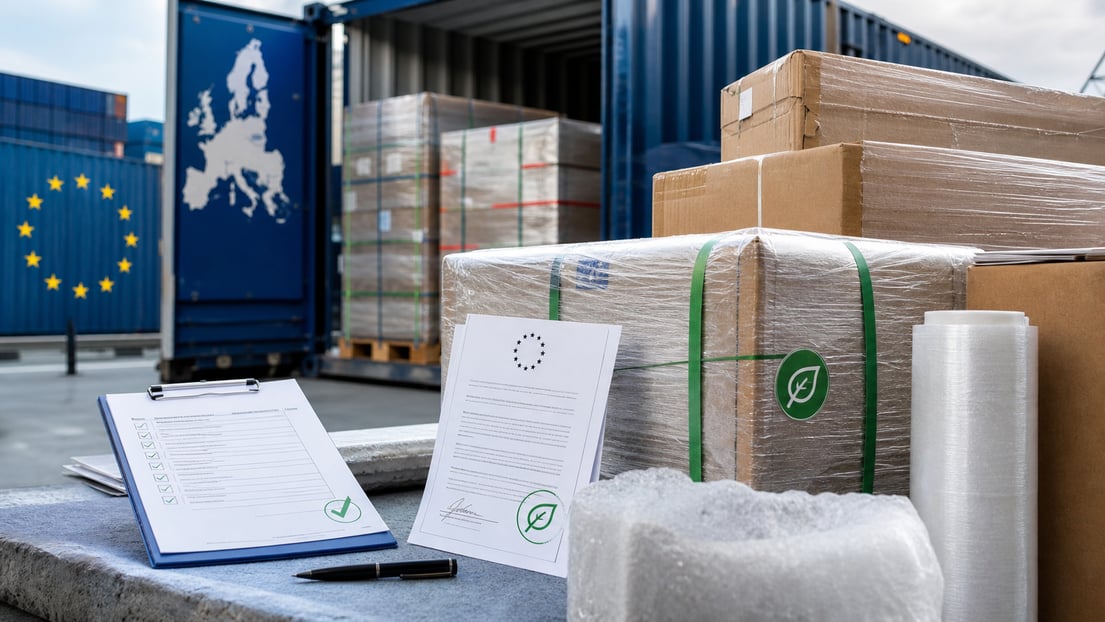
- EU Declaration of Conformity: the manufacturer (your supplier, or yourself if you are considered the manufacturer) must prepare a declaration for each type of packaging. The importer must hold a copy for each packaging type, verify that the conformity assessment has been carried out and be able to provide the technical documentation to market surveillance authorities upon request.
- Technical documentation: it must cover the packaging composition, evidence relating to regulated substances (particularly lead, cadmium, mercury and hexavalent chromium, limited to a combined total of 100 mg/kg), and, since 12 August 2026, evidence relating to PFAS for packaging intended to come into contact with food.
- Importer identification: your name or company name, postal address and electronic contact details must appear on the packaging, or be provided using the alternative methods permitted under the regulation.
- Retention period: declarations of conformity must be retained for 5 years for single-use packaging and 10 years for reusable packaging.
No grace period applies to packaging placed on the market from 12 August 2026 onwards. Goods that have not yet been placed on the market require compliance documentation, regardless of their date of manufacture. This point is particularly important for goods already in transit or orders placed before the regulation became applicable: the date on which the goods are released for free circulation in the EU, rather than the date of manufacture, is decisive.
PPWR and imports from abroad: what changes operationally
For supply chain departments sourcing from Asia, the PPWR introduces an additional layer of supplier verification that cannot be delegated.
Importers must verify the compliance and documentation of their suppliers before placing products on the EU market. Legal responsibility lies with the importer, not with the non-European factory.
In practice, this means that a supplier may deliver non-compliant packaging or fail to provide adequate documentation — and responsibility for that non-compliance will be borne by the French company importing the goods. Customs authorities, working with market surveillance authorities, may intervene when goods enter the European territory.
Under the regulation, where an authority identifies non-compliance, it requires the economic operator to take appropriate corrective measures within a reasonable and proportionate timeframe. If the non-compliance persists, the authorities may go as far as prohibiting the packaging from being made available on the market, or ordering its withdrawal or recall. This phase should be seen as an opportunity to regularise the situation — but only if the company can demonstrate that corrective action is actively underway.
For international companies, the PPWR means that even imported packaging or packaging originating from third countries must comply with the new requirements from August 2026 onwards.
The timetable for upcoming obligations: what you need to anticipate today in your specifications
PPWR obligations are phased in through to 2040 — but they need to be incorporated into supplier requirements now.
Applicable in its main provisions from 12 August 2026, the regulation gradually introduces new requirements relating in particular to composition, recyclability, recycled content, reuse, reduction of packaging weight and volume, labelling and the documentation required to demonstrate compliance.
The next deadlines to anticipate in your purchasing processes are:
- From 2028 at the earliest: introduction of harmonised labelling indicating packaging composition to facilitate sorting. Compostable packaging falling within the relevant categories will also need to be substantiated from 12 February 2028.
- From 1 January 2030: maximum recycled plastic content rates for certain categories, requirements to minimise weight and volume (Article 10 of the regulation), and a maximum empty-space ratio of 50% for grouped, transport and e-commerce packaging.
- Reuse of transport packaging from 2030: for certain categories (pallets, crates, boxes, drums and IBCs), a general target of at least 40% reusable packaging for the relevant flows within the EU.
According to the Paris Île-de-France Chamber of Commerce and Industry, the overall objective is to reach 70% recycling by 2025 and 75% by 2030.
Integrating these future requirements into supplier specifications now is essential to avoid having to redesign packaging urgently as each deadline approaches.
FAQ: PPWR, importer obligations and compliance of imported packaging
Q: As an importer, am I subject to the PPWR even if I only import finished packaged products?
A: Yes. The PPWR applies to all packaging placed on the European market, regardless of the country of origin. Once you import packaged products and release them for free circulation in the EU, you are considered an economic operator under the regulation, with specific documentary obligations: verifying packaging compliance, retaining the EU Declaration of Conformity and being able to provide the technical documentation to the authorities upon request.
Q: Is my supplier responsible for PPWR compliance on my behalf?
A: No. Importers must verify the compliance and documentation of their suppliers before placing products on the EU market. Legal responsibility lies with the importer, not with the non-European factory. Your supplier must provide the EU Declaration of Conformity and the technical documentation, but it is your responsibility to collect, verify and retain them.
Q: Which types of packaging are covered by the PPWR in a typical import supply chain?
A: The regulation covers all types of packaging: primary packaging (around the product), secondary packaging (grouping) and tertiary packaging (transport). Filling materials are counted as empty space rather than product volume. Cardboard boxes, plastic films, protective foams, strapping and pallets are all covered when they accompany goods placed on the European market.
Q: Is there a grace period for goods manufactured before 12 August 2026?
A: No grace period applies to packaging placed on the market from 12 August 2026 onwards. Goods that have not yet been placed on the market require compliance documentation, regardless of their date of manufacture. The date of release for free circulation in the EU is the determining criterion, not the manufacturing date.
Q: What are the risks for a company that does not comply with the PPWR documentary obligations?
A: If non-compliance is identified, the authorities may require corrective measures within a reasonable timeframe. If the situation is not regularised, they may prohibit the packaging from being made available on the market, order its withdrawal or recall, and apply the penalties provided for under the national legislation of each Member State. Demonstrating that an active compliance process is underway remains the best way to limit exposure.
Conclusion: PPWR compliance is a supply chain issue, not just a legal issue
Regulation (EU) 2025/40 cannot be managed by the legal department alone. It directly involves purchasing, supply chain and import-export teams, because a documentary response must be provided for every flow, every packaging family and every supplier.
Request support for your customs and import/export challenges: ThemaTrans analyses your import flows, identifies your PPWR regulatory exposure and helps you structure the documentary compliance process with your suppliers — with a pragmatic, solution-oriented approach that is fully integrated into the operational realities of your organisation.
Sources :
- Règlement (UE) 2025/40 du Parlement européen et du Conseil du 19 décembre 2024 relatif aux emballages et aux déchets d'emballages — EUR-Lex : https://eur-lex.europa.eu/legal-content/FR/TXT/HTML/?uri=OJ:L_202500040
- Direction générale des douanes et droits indirects (DGDDI) — douane.gouv.fr : « Entrée en vigueur du nouveau règlement relatif aux emballages », août 2026
- Commission européenne — DG Environnement : présentation