
It is all of your transport flows: what is shipped or received, from where to where, in what quantity, with which carrier, within what lead time and at what cost. Auditing it means checking that this organisation is still the best suited.
Transport Plan Audit
Understand your flows, identify where your transport costs come from and pinpoint practical levers to reduce them while improving service.
Who is it for?
Companies whose transport budget is rising, that work with several carriers or that lack visibility over their flows.
What we do
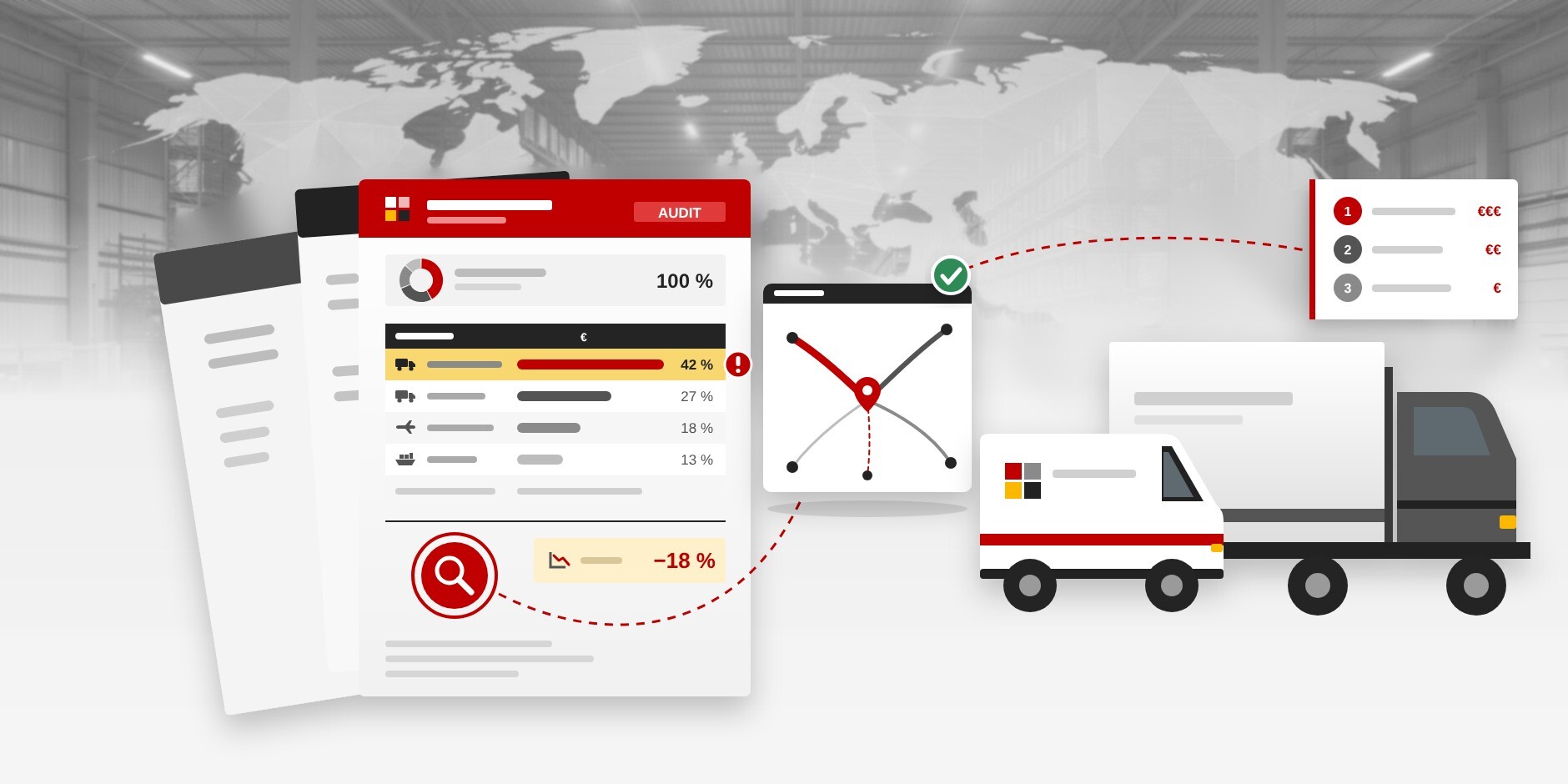
We map your flows, analyse your costs and carriers, then compare them with the market and with your service needs.
What you get
A clear summary of your flows, a detailed analysis of your costs and a costed, prioritised action plan.
Objective
Over time, flows change, carriers pile up and rates are negotiated case by case. As a result, it becomes hard to know what transport really costs, who generates those costs and whether the service delivered meets your customers’ expectations.
Our goal: to give you a complete, quantified view of your transport plan, compare it with the market and with your needs, then identify operational and strategic areas for improvement.
What we find most often
- Too many carriers for similar flows, or on the contrary dependence on just one
- Rates above market on certain destinations
- Too many urgent or express shipments
- Costs poorly allocated between customers, products or cost centres
- Service level poorly matched to customers’ real expectations
How the assignment works
A structured audit, from the data to the action plan.
-
01
Data collection
You send us your invoices, shipment extracts, contracts and rate cards.
-
02
Flow mapping
Origins, destinations, volumes, transport modes and carriers: we make your flows easy to read.
-
03
Cost analysis
Cost per shipment, per destination, per customer or cost centre: we identify what weighs the most.
-
04
Team interviews
A few interviews with your teams (customer service, logistics, sales) to compare the service expected with the service delivered.
-
05
Market benchmark
We position your rates and practices against the current market.
-
06
Action plan
Costed, prioritised recommendations, from quick wins to longer-term projects, presented at a review meeting.
Our commitments
A clear summary
A view of your flows that everyone can understand, not just the experts.
Costed recommendations
Each recommendation comes with its estimated gain.
Independence
An outside view, with no ties to your current carriers.
Decision support
Clear priorities so you know where to start.
Your benefits
A complete view
You know who carries what, where, and at what price.
Costs understood
You identify the items that weigh the most and how to reduce them.
Clear priorities
An action plan split between quick wins and longer-term projects.
A solid basis for negotiation
Reliable data for your next tenders or renegotiations.
Mission example
Household appliance manufacturer, SME
We analysed all of this SME’s shipments and reviewed its 5 carriers. The audit revealed 7% potential savings, around €50K on the annual transport budget studied.
23,426
shipments analysed
5
carriers reviewed
€50K
potential savings per year (7%)
What is a transport plan?
What data do we need to provide?
Ideally 12 months of transport invoices, an extract of your shipments (from your ERP or your files), plus your contracts and rate cards. If the data is incomplete, we help you rebuild it.
How long does the audit take?
Usually a few weeks, depending on the volume of your flows and the quality of the data available. We give you a precise schedule after an initial review.
Will our teams be heavily involved?
No. Beyond sending the data, we hold a few targeted interviews with the people concerned (customer service, logistics, sales, finance) to understand your constraints and expectations.
What does the final report contain?
A map of your flows, an analysis of your costs and carriers, a market comparison and a costed, prioritised action plan. It is presented to you at a review meeting.
What is a cost centre?
It is the entity to which an expense is allocated: a customer, a site, a product range or a department. Allocating transport costs by cost centre shows who really generates them, and therefore where to act.
Does the audit cover international flows?
Yes. We analyse all your flows, import and export: road, sea, air and express parcels.
What happens after the audit?
You can implement the recommendations with your teams, or entrust us with the next steps: transport tender, freight invoice audit or day-to-day support for your teams.
You may also be interested in
Do you really know what your transport costs you?
Let’s talk: 30 minutes, free of charge and with no commitment.


